
Key Questions to Ask Before Hiring a Commercial Fleet Wrap Expert
A commercial fleet wrap expert should answer your questions with specifics you can check. Vague answers are the first warning sign. This guide gives you eight questions, what a strong answer sounds like, what a weak one sounds like, and how we answer each one ourselves.
We wrap vans, box trucks, trucks, and trailers, so the examples use those. A scorecard near the end lets you rate any vendor, including us.
Which fleets have you wrapped, and do they look like mine?
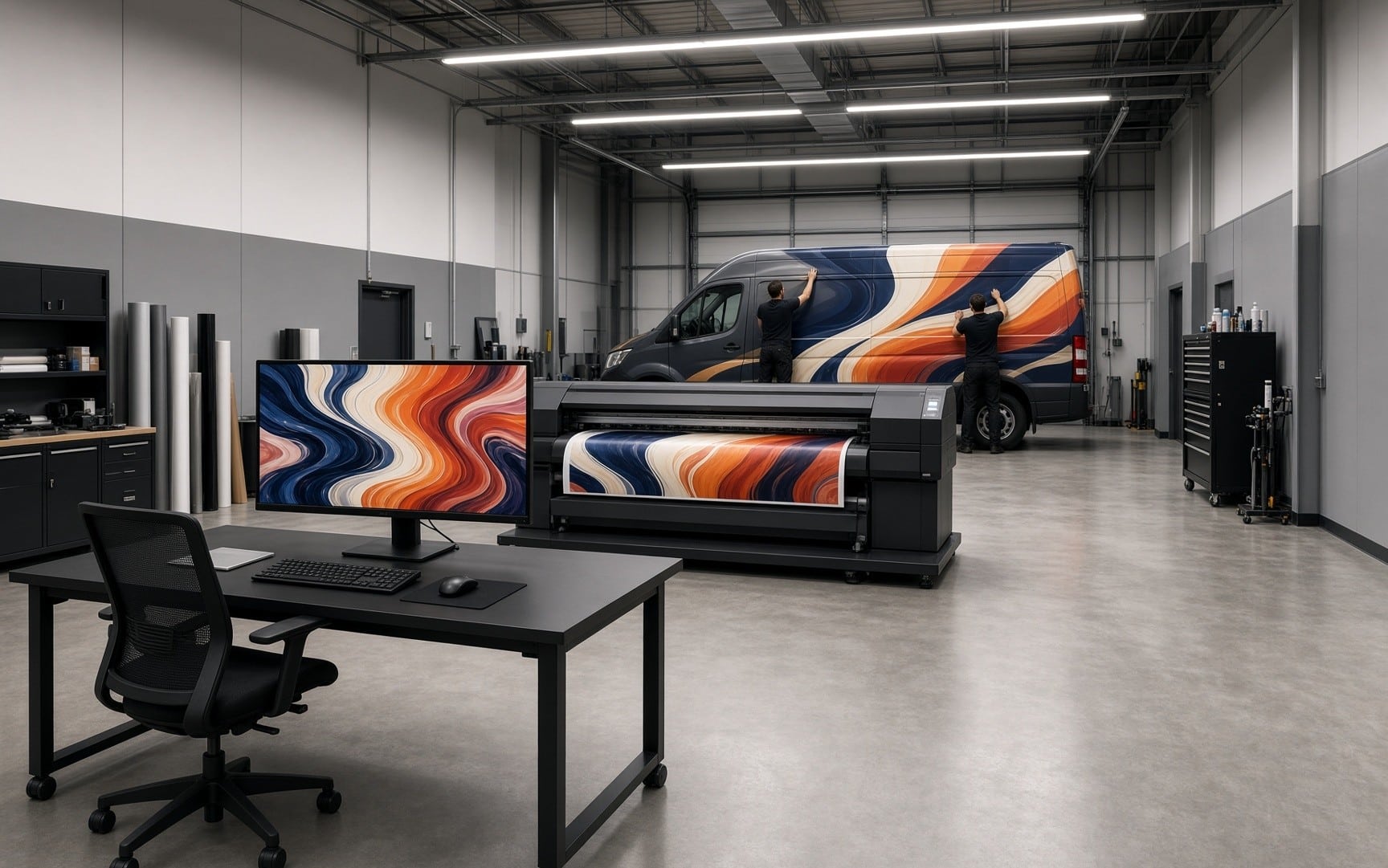
Ask for fleets close to yours in vehicle type and size. Experience with fifty vans says little about a mixed fleet of vans, box trucks, and trailers. Then look at several vehicles from one fleet side by side and up close, because a fleet's consistency shows in the edges and seams.
A strong answer: names vehicle types and fleet sizes, and offers a portfolio or references you can contact.
A weak answer: "All kinds of vehicles," with no examples.
Our answer: we have wrapped more than 10,000 vehicles and complete about 2,500 projects a year. Our projects range from a single work truck to a fleet of fifty, with no fleet minimum. We wrap vans, box trucks, trucks, and trailers, including 53-foot semi trailers. See our Portfolio and Commercial Fleet Wraps.
Which films, laminates, and printers do you use, and who stands behind them?

The vendor should name the film line, the laminate, and the printer, and say which manufacturer backs the material.
A strong answer: product names, cast film for the curved surfaces of vehicles, and a manufacturer behind the warranty.
A weak answer: "High-quality vinyl," with no brand or product.
Our answer: we use 3M and Avery Dennison wrap films. Our most common combination is Avery Dennison MPI 1105 cast vinyl with DOL 1460Z gloss cast overlaminate, printed on HP Latex printers. We buy enough 3M and Avery Dennison material that both manufacturers stand behind our material claims. For how those choices hold up across seasons, read How We Build One Wrap to Survive a Utah Winter and a Nevada Summer.
Who is certified, and how do I verify it?

Ask for the exact program name, then check it with the manufacturer. Look for these names: 3M Preferred Installer, 3M Certified Graphics Installation Company, and Avery Dennison Certified Wrap Installer. Both manufacturers publish an installer finder where you can look up a shop.
Find out who holds the certification too. Some programs certify individual installers, while others certify the installing company.
A strong answer: the exact program name, who holds it, and a listing you can find in the manufacturer's finder.
A weak answer: "We're certified," with no named program.
Our answer: We are 3M- and Avery Dennison-certified, and our installers hold the certifications.
Who designs, prints, and installs, and what do you outsource?

Expect a direct answer on each step, including who physically puts the film on your vehicle. Every handoff between designer, printer, and installer is a place where details can change.
A strong answer: design, printing, and installation answered separately, with any outside installer named as one and held to a stated standard.
A weak answer: "Our team handles it," with no detail.
Our answer: our in-house design team creates every wrap, and we print every wrap ourselves. Our own installers handle most projects in Salt Lake City and Reno. We use certified outside installers who meet our standard for some Las Vegas projects, for occasional projects in Salt Lake City and Reno, and for work outside Utah and Nevada. See Salt Lake City, Las Vegas, and Reno.
How do you keep every vehicle matching?

Ask how one design becomes many layouts. A van, a box truck, and a trailer have different panels, so each body type needs its own layout built from one master design. A fleet that mixes the three shows the problem fastest.
A strong answer: one master file, a layout for each body type, an approved mockup before printing, and the same process at every location or installer.
A weak answer: "We'll just resize the file."
Our answer: We build one master design and apply it across your fleet. We build our own vehicle templates, so each layout fits its vehicle. You approve a mockup before anything prints. All of our locations follow the same design and production process, so vehicles in different cities match. See Commercial Truck Wraps and Commercial Van Wraps.
How will you schedule installs, and how long is each vehicle down?

Before quoting a timeline, a strong vendor asks about your operation. Expect questions about each vehicle: make, model, and year, plus unit number or asset ID. Expect questions about where it is, when it can leave service, and who releases it to the installer. Then expect a per-vehicle estimate and a phased plan. One to three days per vehicle is a typical range for a full wrap.
A strong answer: questions first, then a per-vehicle estimate and a schedule built around your operation.
A weak answer: a precise total with no questions, or a window so wide it says nothing.
Our answer: most single vehicles are wrapped and back on the road within 1 to 3 business days. We schedule fleet installs to keep your vehicles in service, and we can wrap a large fleet in phases.
What does the quote cover, and what does it cost?

A quote should be built by vehicle type and coverage, with what is included written out. Compare quotes line by line, because the lowest total can hide missing steps.
A strong answer: a quote itemized by vehicle and coverage, a stated fleet discount, and a plain explanation of what changes the price.
A weak answer: one lump sum, or a price that moves after design.
Our answer: partial wraps start at $1,900, and full wraps cost more. Fleet discounts go up to 15%, and there is no fleet minimum. Every quote is based on your actual vehicles. For planning ranges by vehicle type, see How Much Does It Cost to Wrap a Vehicle?
What happens when a wrap fails or gets damaged?

Find out what each warranty covers and who handles a claim. A product warranty covers the material, and an installation warranty covers workmanship. A strong vendor explains both and describes what a repair looks like.
A strong answer: product and workmanship coverage stated separately, a named process for claims, and a clear repair or touch-up option.
A weak answer: "We'll take care of you," with nothing specific.
Our answer: our wraps carry a 5-year product warranty on the material and a 1-year installation warranty on workmanship. We review claims case by case, and we repair and touch up wraps. Depending on the situation, we cover a repair under warranty or quote it. For what to expect over the life of a wrap, see How Long Does a Vehicle Wrap Actually Last?
Scorecard
Score each answer from 0 to 2. A 2 is specific and checkable, a 1 is general, and a 0 is vague or refused. Add the scores to compare vendors, and use any 0 as the starting point for follow-up questions. A 0 on certification, who installs, or warranty deserves an answer before you sign.
| Question | Strong Answer | Weak Answer | Score (0 to 2) |
|---|---|---|---|
| Which fleets have you wrapped? | Vehicle types and fleet sizes close to yours, with a portfolio or references | "All kinds of vehicles" | |
| Which films, laminates, and printers? | Named products and a manufacturer behind them | "High-quality vinyl" | |
| Who is certified? | Exact program, holder, and a finder listing | "We're certified" | |
| Who designs, prints, and installs? | Each step answered, outside installers named. | "Our team handles it" | |
| How do vehicles match? | One master file, a layout per body type, an approved mockup | "We'll just resize the file" | |
| How are installs scheduled? | Questions first, then a per-vehicle estimate and phases | A precise total with no questions | |
| What does the quote cover? | Itemized by vehicle and coverage | One lump sum | |
| What happens when a wrap fails? | Product and workmanship coverage, a claims process | "We'll take care of you" |
Frequently Asked Questions
Can I wrap leased fleet vehicles?
Often yes, with the lessor's written approval. Check each lease, because many require approval for any exterior change and expect the wrap to come off before the vehicle goes back. We can remove wraps when a lease ends.
Do I have to wrap the whole fleet at once?
No. A phased install keeps vehicles in service. We have no fleet minimum, and we can wrap a large fleet in phases to limit disruption.
Can one vendor handle a fleet in several states?
Yes. We have locations in Salt Lake City, Reno, and Las Vegas, and certified outside installers who meet our standard cover other areas. One national customer told us that having us manage its wraps across the country beats dealing with 21 different vendors.
What should I have ready before asking for a quote?
Have the make, model, and year of each vehicle, plus unit numbers or asset IDs. Note where each vehicle is and any existing graphics that need removal. Bring your artwork or brand files. Our in-house design team can create artwork when you have none.
The Bottom Line
Ask for specifics, check what you can, and score the answers. The right commercial fleet wrap expert names its films, certifications, and installers. It explains how every vehicle will match, plans around your downtime, and says plainly what its warranty covers.
We answer all eight questions in this post, and we will answer them again for your fleet. To start, get a Quote. You can also see our Salt Lake City, Las Vegas, and Reno pages.


