
How Much Does It Cost to Wrap a Vehicle? Real Pricing by Car, Van, Truck, and Bus
The Short Answer
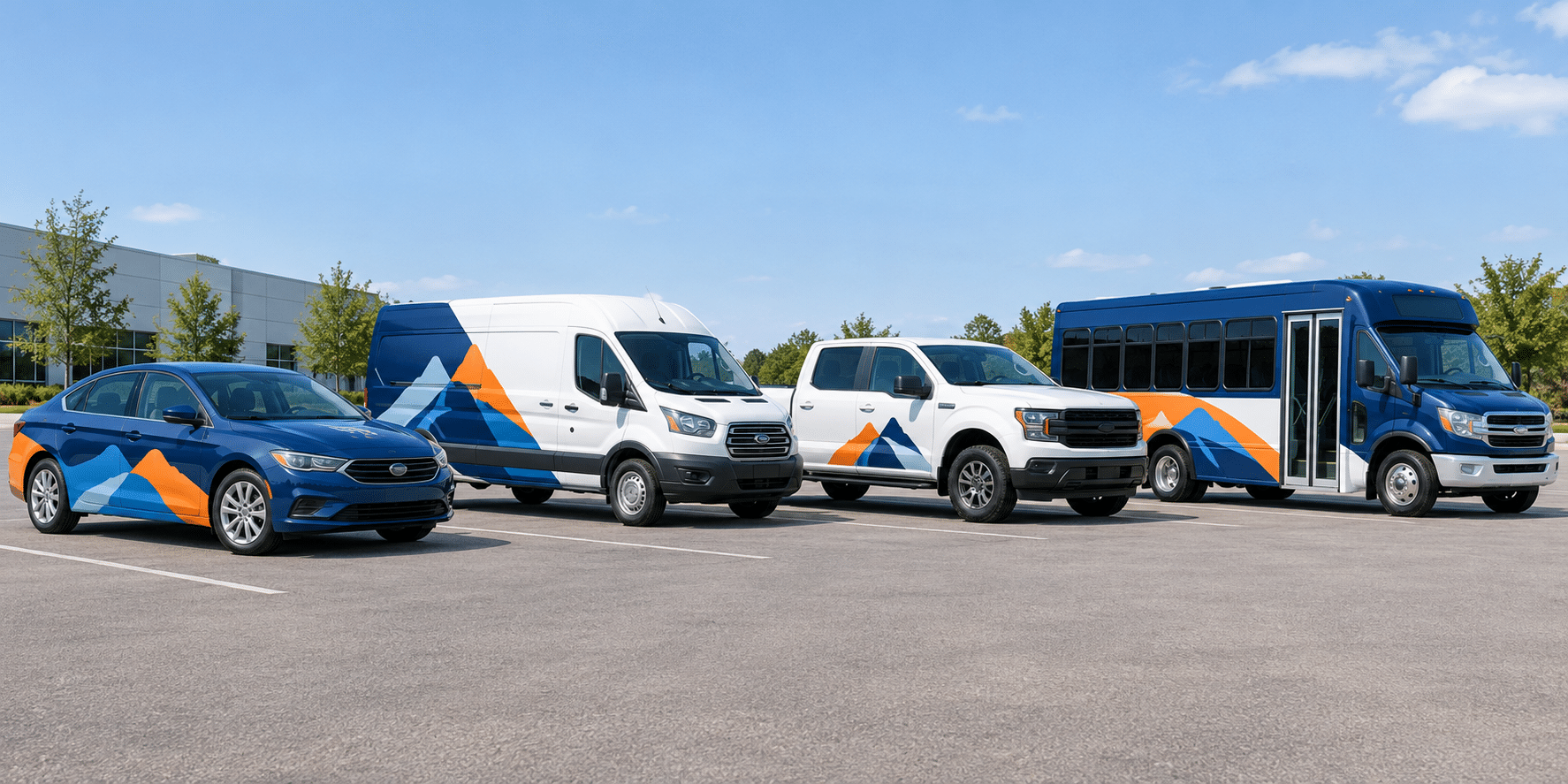
Vehicle wrap costs range from a few hundred dollars for basic lettering to $10,000 or more for a full wrap on a large bus. The honest answer to how much it costs to wrap a vehicle is that it depends entirely on what you're wrapping and how much of it you're covering. Below is the real range by vehicle type, coverage level, and how our pricing compares.
Cost by Vehicle Type

Size and shape are the two biggest cost drivers, more than any single other factor. A compact sedan and a 20-foot box truck aren't remotely the same job, so treating them as one price range would be dishonest.
Cars & Sedans
A full wrap on a car or sedan generally runs $2,000 to $4,500, depending on the vehicle's size and body complexity. Partial wraps typically cost $1,000 to $2,000. Basic lettering and spot graphics (logo, phone number, contact info) start around $300 to $800.
Vans
How much it costs to wrap a van depends heavily on which kind of van. A standard cargo van typically runs $3,000 to $5,500 for a full wrap; a taller Sprinter or transit-style van, with more surface to cover, runs $4,000 to $7,000. Partial van wraps sit around $1,500 to $3,500, and lettering-only jobs usually come in under $1,000.
Trucks
A full wrap on a pickup generally runs $3,000 to $6,000, and cab configuration (regular, extended, or crew) plays a real role in that number. Box trucks cost more, typically $5,000 to $10,000 or higher, since there's simply more surface to print and install. Partial truck wraps run $1,500 to $3,000.
Buses
This one's worth separating clearly from bus advertising rental rates, which are a completely different thing. Advertising rental rates are monthly fees for renting ad space on a public transit bus you don't own. The actual cost to produce and install a wrap on a bus your business owns runs $1,500 to $4,000 for a partial wrap, and $6,000 to $10,000 or more for a full wrap, depending on the bus's size. A smaller shuttle bus lands toward the lower end of that range; a full-size city transit coach lands toward the top.
Quick Reference
| Vehicle Type | Lettering / Spot Graphics | Partial Wrap | Full Wrap |
|---|---|---|---|
| Car / Sedan | $300 – $800 | $1,000 – $2,000 | $2,000 – $4,500 |
| Cargo Van | Under $1,000 | $1,500 – $3,500 | $3,000 – $5,500 |
| Sprinter / High-Roof Van | Under $1,000 | $1,500 – $3,500 | $4,000 – $7,000 |
| Pickup Truck | — | $1,500 – $3,000 | $3,000 – $6,000 |
| Box Truck | — | $1,500 – $3,000 | $5,000 – $10,000+ |
| Bus | — | $1,500 – $4,000 | $6,000 – $10,000+ |
These are planning ranges, not quotes. The exact number depends on your specific vehicle and design.
Full Wrap vs. Partial Wrap vs. Lettering: How Coverage Changes the Price

Coverage level moves the price more than almost anything else, more than vehicle size in a lot of cases. A full wrap covers the entire vehicle, bumper to bumper, for maximum visibility and the strongest brand presence. A partial wrap covers key panels (usually 40 to 70 percent of the vehicle) at a meaningfully lower cost while still delivering real visibility.
Lettering and spot graphics cover just the essentials (logo, name, phone number) at the lowest cost of the three.
None of these is automatically the right choice. A delivery van that's constantly visible might get more value from a full wrap. A service truck that's mostly parked at job sites might do just as well with a well-placed partial wrap. The coverage level should match how and where the vehicle actually gets seen, not just the available budget.
What Actually Makes a Wrap Work

A wrap has about three seconds to answer three questions for someone glancing at it: who is this, what do they do, and how do I contact them? That's the entire design brief, and everything else is secondary.
The most common failure isn't bad color choice or cheap material; it's cramming in too much. A phone number, a website, a tagline, a list of services, and a logo all competing for the same three seconds usually means none of them actually register. Hierarchy matters more than volume: one clear headline element, one clear contact method, everything else supporting rather than competing.
Contrast does more work than most people expect, too. Text needs to read clearly at highway speed and from across a parking lot. A design that only looks good up close on a screen doesn't do its job out on the road.
The Mistakes That Quietly Kill Leads

A few specific mistakes show up often enough to name directly.
Too much text: A wrap covered in five services, three certifications, and a mission statement reads as noise, not information, from more than a few feet away.
Low contrast: Light gray text on a white vehicle, or a logo color that blends into the base wrap color, can look fine in a design file and disappear entirely on the road.
Mismatched coverage to message: Cramming a full-wrap amount of detail into a lettering-level design (or the reverse, leaving a full wrap mostly blank) wastes the coverage level being paid for either way.
Inconsistent design across a growing fleet: This one's common enough to deserve its own section below.
What a Wrap Can Actually Bring In Each Day
A wrap parked in a driveway or at a job site all day isn't sitting idle; everyone who passes still sees it. We've built out the real math on this, using actual pricing instead of the unsourced "daily impressions" statistic repeated across the industry in Vehicle Wrap Advertising Cost: What You're Really Paying Per Impression. Worth a read if you need cost-per-impression to justify a wrap to a business partner or a budget line.
Designing for Consistency Once You're Wrapping More Than One HVAC Vehicle

Pricing one van is straightforward. Pricing (and designing) a second, third, or eighth HVAC vehicle is a different problem, and it's worth planning for early rather than discovering it the hard way.
The issue isn't cost; it's consistency. A design built without a system in mind tends to drift: a slightly different blue on vehicle three, a logo sitting a few inches off on vehicle five. A fleet that's supposed to read as one business starts looking like several. Building the design as a reusable system from the first vehicle avoids that, so vehicle eight ends up looking exactly like vehicle one, just newer.
See our HVAC Vehicle Wraps page for the sub-vertical-specific breakdown, or Commercial Fleet Wraps for how fleet pricing and staged rollouts work once you're past a single vehicle. Fleets also get a real discount (up to 15% off on multi-vehicle orders), so the math improves as the fleet grows, not just the total bill.
How Our Pricing Compares
Our own pricing: partial wraps start at $1,900, with full wraps costing more depending on vehicle size and coverage. Against the ranges above, that starting point sits within the typical partial-wrap range for a smaller vehicle. This reflects the materials (3M and Avery Dennison, both certified) and the fact that one team handles design, printing, and installation instead of splitting the work across vendors.
We don't publish a flat full-wrap number, for the same reason none of the ranges above are a single number: it genuinely depends on the vehicle. What we can say plainly is that $1,900 is a starting point, not an average or a ceiling.
Two things to clarify when comparing quotes. First, that price includes design. Some shops quote the wrap itself and then add a separate design fee. Ours doesn't work that way, since design, printing, and installation are one project.
Second, material grade is a real reason prices vary this much between shops for what looks like the same job. Budget vinyl can look identical to cast vinyl on day one and start failing within a year or two; properly installed cast vinyl lasts 5 to 7 years. A lower quote elsewhere isn't automatically the better deal if it's built on a thinner material.
FAQ
How much does it cost to wrap a vehicle?
Costs typically range from a few hundred dollars for lettering to $10,000 or more for a full wrap on a large bus. Size, coverage level, and material quality are the three biggest factors. See the vehicle-by-vehicle breakdown above for a more specific range.
How much does it cost to wrap a truck?
A full wrap on a pickup truck generally runs $3,000 to $6,000. Box trucks cost more, typically $5,000 to $10,000 or higher, since there's more surface to cover.
How much does it cost to wrap a van?
A full wrap on a standard cargo van typically runs $3,000 to $5,500. Taller Sprinter-style vans run $4,000 to $7,000 due to the extra surface area.
How much does it cost to wrap a bus?
Partial bus wraps run $1,500 to $4,000. Full wraps run $6,000 to $10,000 or more depending on bus size. This is separate from bus advertising rental rates, which are a monthly fee for ad space on a transit bus, not a production cost.
How long does it take to install a vehicle wrap?
A single vehicle typically takes 1 to 3 business days from install start to finish, depending on size and coverage. Design and production time before installation adds more and varies by project.
Is a partial wrap worth it, or should I go full?
A full wrap makes more sense for a vehicle that's constantly on the road and highly visible. A partial wrap works just as well for a vehicle that mostly sits at job sites, at a lower cost.
Does removing a wrap damage the paint?
No, as long as the paint was in good condition before wrapping and you remove the wrap within its rated lifespan. We cover this in full in Does Wrapping a Vehicle Damage the Paint?
Is a vehicle wrap cheaper than a paint job?
Often, yes, especially for anything beyond a basic single-color job. A quality custom paint job commonly runs $5,000 to $15,000 or more and adds no advertising value. A wrap in the same price range doubles as marketing and can be removed or updated later without touching the factory paint underneath.
The Bottom Line
Vehicle wrap cost isn't one number. It's a range that depends on vehicle size, coverage level, and what the wrap actually needs to do. A sedan with lettering and a full-size box truck with complete coverage are different jobs with different price tags, and treating them as one flat rate would be misleading.
What stays consistent is the math underneath it: a wrap is a one-time cost that keeps working long after it's paid for. Whether it's one van or a growing HVAC fleet, the logic is the same. Our own starting point, $1,900 for a partial wrap, sits honestly within the ranges above, backed by materials and a process built to make that number worth it.



